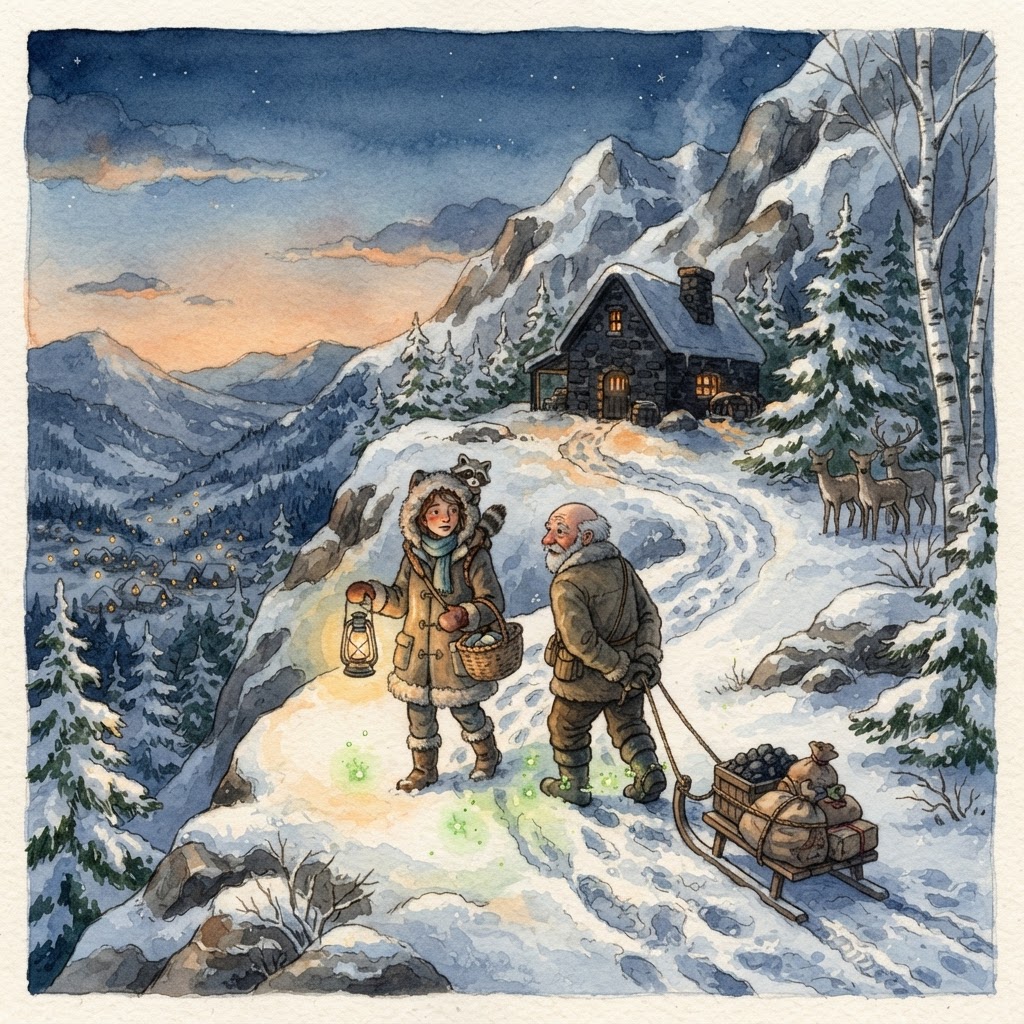
It came on as the longest winter the lane had seen in living memory. Snow buried the hedgerows of Bramblebrook Hollow, the brook fell silent under a thick grey lid, and the wind over Copperscale Ridge howled like something wounded. Down in the mead, Pip lit the faerie fire each evening all the same — bright and warm, but never hot, and in a winter that bitter even its gentle warmth was a small thing against the cold — and the folk gathered close and told longer stories than usual, because stories are a kind of heat.
But one hearth stayed dark. Rhonan Coppersmith, up on the ridge, had not come down in three weeks. The folk knew he kept to himself; they knew, too, that his metal boot made the deep snow a slow, painful business. What they did not know — and what Rhonan would never say — was that his coal store had run low, and his flour was nearly gone, and that the big bald man who could bend iron to his will had begun, very quietly, to be afraid.
Roa noticed first. She had taught too many winters to miss the signs. She said nothing at the feast, only went home and set a bowl of cream on her back step, as she always did, and whispered to the dark that the ridge path might need clearing. Whether the brownies heard, or simply fancied the cream and a good excuse, no one can say. They are not always kind, brownies. But kindness, the lane believes, has a way of making even the unkind willing — for a night, at least — and by dawn the worst of the drifts on the ridge path had been stamped down into something almost walkable, and the cream was gone.
Pip filled a basket. Maren Mossbeard wrapped her strongest tea against the cold. The baker tucked in a dark loaf, and someone — no one ever claimed it — slipped in a jar of honey with a bit of twine around its neck and no note at all. And Aldric — old Aldric, who seldom left the school porch — came out with a small sled he had built years before and never spoken of, loaded with coal and a wrapped cut of meat and a little pouch of oil. For a man his age he was unusually strong and nimble, and he pulled that sled up the ridge path as though it were nothing at all. Pip set the basket on his shoulder and started up the ridge beside him, with his raccoon Bandit riding in the hood of his coat, and the faeries of the forest, who know every root and stone, lit their way with small green sparks that hovered just ahead of their boots. The deer stood at the treeline and did not startle, only watched them pass, as if standing guard.
He found the smithy dark and the door half-barred. He did not knock. He set the basket on the step, tucked a bit of bread just inside the door where it could not be missed, and went home the long way so Rhonan would not have to meet anyone's eyes.
For three days no one spoke of it. On the fourth, a parcel arrived at the mead with no name on it: a copper lantern, hammered fine as anything, set with a single pale stone that caught the faerie fire and held it, burning steady and soft long after the others had gone dim. Pip hung it at the center of the mead, and it became the one the folk lit first each evening, and the one that lasted longest into the night. Rhonan never came down to see it. He did not need to. He knew it was there.
And that is the whole of the lane's oldest belief, the one Roa teaches the children on the porch each autumn while Aldric rings the little school bell and says nothing: that kindness, once given, does not stay where you left it. It walks the hedgerows and the high ridges. It borrows the hands of brownies and the eyes of deer. It wanders a while — and then, when the need is greatest and the night is longest, it finds its way home.

