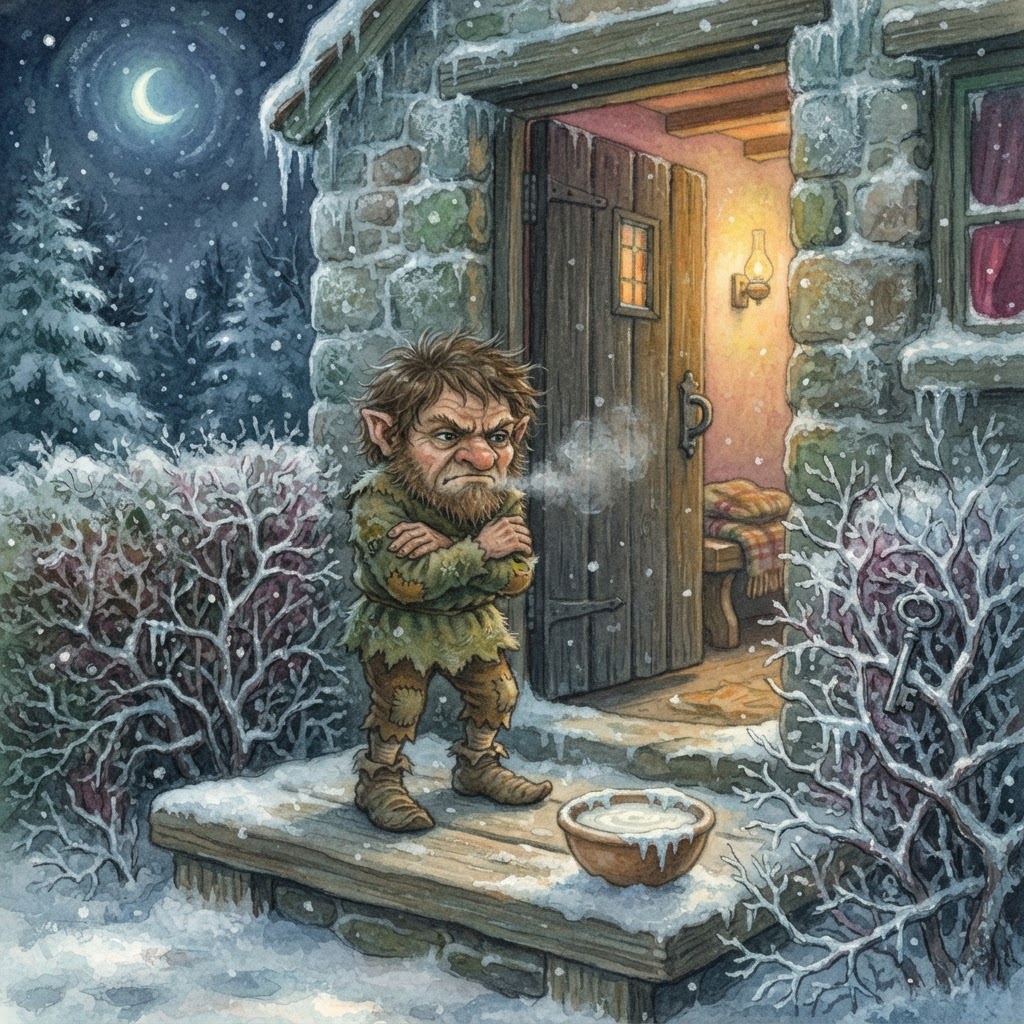
There is a kind of brownie on the lane that will do your chores for you, if you leave a bowl of cream on the step before you sleep. It is an old bargain, and a fair one, the folk say, so long as you keep your side of it. But the folk also tell their children, when the lamps burn low, about a brownie who could not keep his — not because he lacked the cream, but because he could not bring himself to trust that it would be there.
His name was Nib, and he lived under the cellar step of a cottage in the hollow, and he was the spitefulest brownie the lane has ever kept. A brownie will sour the milk and hide the keys if he is crossed — everyone knows this — but Nib was cross before he was crossed. He counted the cream each night to be sure the bowl was full, and if he thought it a hair short he would sour the butter, and tangle the yarn, and hide the good mittens, and blame it all on the wind.
The family whose cottage he kept were patient folk, and kind in the slow way that kind people often are. They left the cream the same each night, full to the brim, and never once complained when the bread came out lumpy or the doorkey went missing for the third time in a week. They understood, the way the lane understands most things, that Nib's sourness was not about the cream at all — it was about being sure. He could not be sure the cream would come, and so he made sure, at least, that something else would suffer for it.
Then came a winter night sharper than any in the lane's remembering. The faerie fire in the lanterns burned bright and warm but never hot, and it was not enough — the wind cut under the eaves and the brook went silent under its ice. Nib, that evening, had hidden the family's doorkey "to teach them a lesson," as he told himself, and tucked it deep in the hedgerow where he was sure they would never find it. But the frost found it first, and by the time Nib crept back to his cellar step, the iron was locked fast in the ice, and his own little door had frozen shut, and the cottage was closed to him.
He meant to rattle the door and scold them for it, because that was Nib's way — but what he heard from inside was the youngest child, hardly more than a babe, saying to her mother, "The brownie will be cold tonight," and her mother answering, "Then we had best leave the door a little open, and a bowl of cream beside it." And they did. They opened the door a hand's width, and set the bowl on the step, and went back to the fire, and said nothing else at all.
Nib would not take it. He was sure, the way he was always sure, that it was a trap — that the child only wanted to catch him, that the cream was only a payment for something, that to step inside was to owe them, and a brownie who owes a thing is a brownie who can be made to do more than he bargained for. So he stood on the frozen step with the bowl of cream before him and the warm door open behind it and refused, out of pure spite, to go in. He got, that night, exactly the dessert his spite had baked him: a cold step, a stiffening wind, and a bowl of the very cream he had always counted, untouched, while warmth waited one step away for nothing but his willingness to take it.
The cold will wait longer than any brownie's pride. By the small hours Nib could no longer feel his toes, and the cream on the step had a skin of ice over it, and the open door still breathed out warmth, and still no one came to fetch him or to scold. He understood, then, what no counting had ever taught him: that the cream on the step had never been a debt or a bargain or a trap. It was trust, plain and given freely — the family trusting him to do the chores, and him trusting them, in return, to leave the bowl — and the only thing in all the lane keeping him out in the cold was his own refusal to believe it could be so.
He went in. The child was asleep by the fire, and the mother had left a blanket folded near the door, as if she had known he would come in his own time and not hers. Nib ate the cream, and slept the night through for the first time in his spiteful life, and in the morning — though no one saw him do it — he found the frozen key in the hedgerow and laid it on the kitchen table where it belonged, and straightened the tangled yarn, and set the mittens back in their places, and did it all without counting whether the cream would come again.
And that, the lane parents say, when the tale is done and the children are heavy-eyed, is why the cream on the step is left full to the brim, and why the chores are done, and why neither side keeps a tally. A bargain kept only because you are sure of your half is a cold thing, and a cold thing will leave you out in the frost sooner or later. Trust is the bowl you have to let yourself be given. Take it, and the door opens of itself; refuse it, and no amount of cream or clever spite will warm you.

