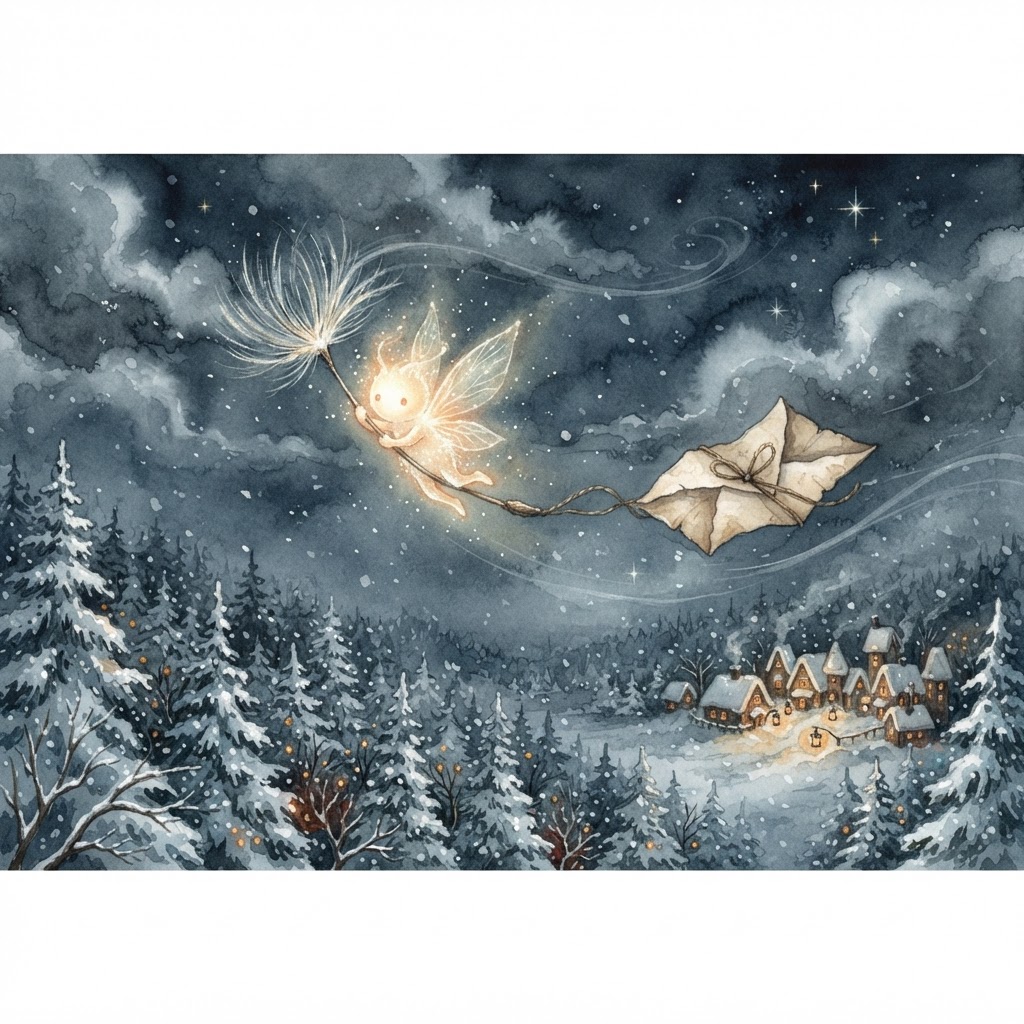
Finn the Thistledown Wisp is the smallest messenger anyone has ever known, and the only one who cannot tell you where a letter came from. He only rides the wind. When a tuft of thistledown catches the right gust, there goes Finn, clinging to the silk of it, trailing a scrap of paper behind him like a kite's tail. He carries his letters in a small pouch of his own making — stitched from a magic acorn and lined with phoenix feathers, lighter than air and bigger on the inside than it has any right to be — so that even a long, heavy letter rides as lightly as a single seed on his tuft. And that is how the lane hears from the world, when it hears at all.
The lane is a quiet place, and quiet places can start to feel like the only place. On long evenings, when the snow sealed the passes and even the dragon-kites stayed low and the brook had nothing to say, the folk would sometimes wonder, the way lonely folk do, whether anyone beyond the hills remembered them at all.
It was on just such an evening, late in a winter that had gone on too long, that Finn came skirling over the Whispering Thicket, blown sideways and soaked through, carrying a letter so old the fold lines had worn to lace. He tumbled onto the long table in the middle of the mead, the letter still gripped in both hands, and lay there shimmering while Pip lifted it gently and Maren pressed a warm cup into the wisp's small bright fingers.
The paper was brittle and the ink had faded to the color of weak tea, and it was written in a tongue no one on the lane read anymore — not Roa, who knew a great deal, nor Aldric, who knew more than he showed. Roa turned the page this way and that and shook her head; the marks were only marks, beautiful and shut. It was Aldric who, without a word, lifted the center lantern and set it down beside the letter on the table — as if he had always known it would help. The faerie fire, bright and warm but never hot, caught the faded page, and the marks stirred. They shifted, the way a reflection shifts on water, and settled again into words the folk could read as plainly as their own names. It was a letter from very far away, written by someone who had once passed through the lane years before — a traveler, it seemed, who had been given a meal and a bed and a place by the fire, and who wanted the folk to know that they had never forgotten it, that on the worst nights of their life they had thought of the mead and the lanterns and the sound of someone laughing over bread, and that it had carried them through.
It had taken the letter longer to arrive than most folk live. It had crossed rivers and seas and the tops of mountains no one on the lane had names for. It had been folded into pockets and lost in attics and blown out of windows and caught again, and at the last it had found the only thing small enough and stubborn enough to bring it the rest of the way: a wisp, riding a single tuft of thistledown, that the wind had been carrying home.
Roa read the letter aloud at the feast that night, the children gathered close, and when she was done no one spoke for a long moment, because there was nothing that needed adding. Then Aldric, who rarely said a thing at supper, lifted his cup and said only this: that the lane is never truly alone, because everyone who has ever passed through it carries a piece of it away — and the pieces, given time and a fair wind, have a way of wandering back.
They set the letter in a frame made carefully, by candlelight, of thin pale wood and a pane of glass blown clean — a quiet gift from the ridge, though no one on the lane would have been surprised to learn whose hands had bent the copper that held it — and hung it beside the mead's center lantern, where the faerie fire would catch its faded gold each evening. And on the coldest nights after that, when the passes were sealed and the world felt very far, the folk would look at it and remember: someone, somewhere over the water and the mountains, was remembering them too.

